

Five queer ceramicists to celebrate this Pride month
In honour of Pride Month, we’re celebrating five artists whose work in clay goes far beyond form and function. For a growing community of queer ceramicists, the studio has become a space of radical self-expression, where themes of identity, desire, gender, and belonging are explored through the medium of clay.
These artists use ceramics as a way of exploring and celebrating gender and sexuality in all their forms.
Grayson Perry
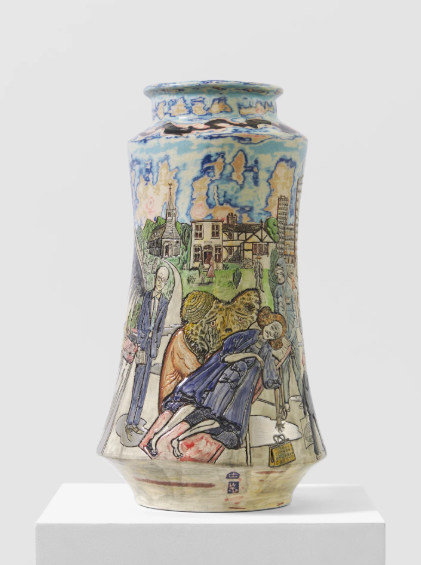
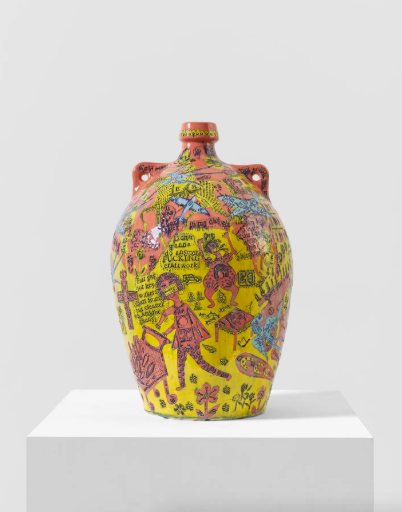
One of the most famous ceramicists working today, Grayson Perry became the first ceramicist ever to win the Turner Prize, in 2003. His vessels have classical forms, and up close they’re covered in rich, decorative imagery that subverts the themes or images commonly presented on those classical forms.
He says of ceramics: “What I liked about it as a vehicle for sharing relatively challenging ideas and images was that the pot always remains this stable thing that everybody understands. So you can really push the boat out but it’s still a pot. It was like, I know what that is and that was an anchor for all the other stuff I wanted to put on there.”
With a range of visual influences, from Greek pottery to folk art, the imagery on Perry’s ceramic vessels explore identity, gender, social status, sexuality and religion. At the centre of his practice is Claire, his female alter ego, who has appeared in his work since the beginning. “It was about me putting on the clothes that gave me the feelings that I wanted,” Perry has said of his cross-dressing; something that began in childhood and has remained inseparable from how he makes art and moves through the world. His work is held in MoMA New York, the Tate Modern, and the V&A.
Adam Chau
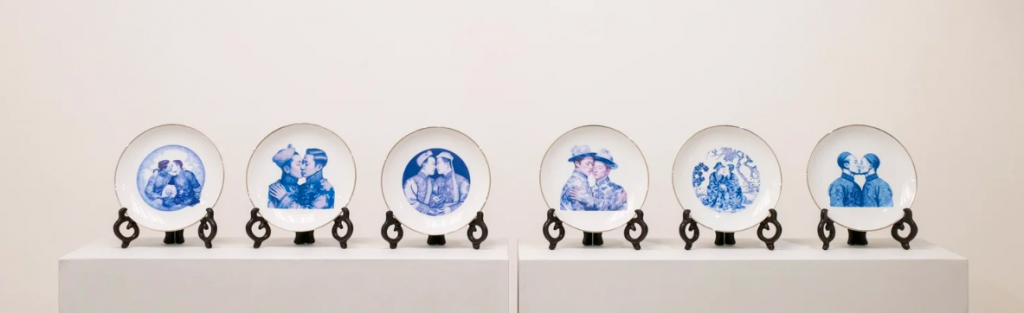
New York-based Adam Chau works in the tradition of Chinese blue-and-white porcelain, but takes it somewhere entirely unexpected. “As an Asian American artist,” he explains, “my concepts revolve around the rich history of blue-and-white porcelain aesthetics, deeply rooted in Asian culture. Fueled by a desire to bridge the past with the future, I try to breathe new life into this medium to ensure that tradition evolves rather than fades.”
Inspired by online dating culture and social media, his work explores the nuances of self-portraiture, as well as queer culture. But his work doesn’t just belong to the present – it also explores queer culture from a historical lens, imagining untold queer histories.
“When I’m in my studio I regularly think about all the queer stories that have never been told or have been erased from the dominant narrative,” he has said. “My priority is to highlight stories about queerness on many different levels, from domesticity to activism.“
His recent Generated Love series used AI to imagine historical images of queer couples, and was exhibited at the Stonewall National Museum and Archives in 2024.
Kathy King
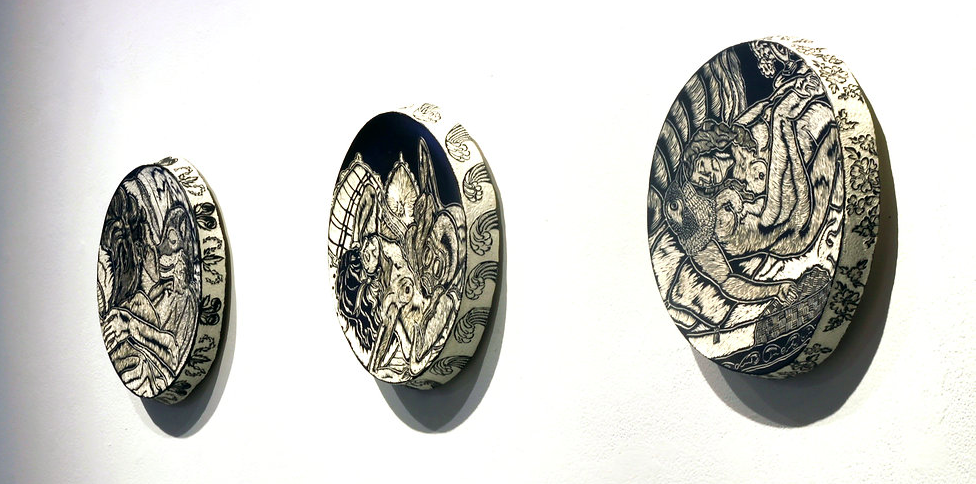
Boston-based KathyKing is the Director of the Ceramics Program at Harvard. She covers thrown porcelain vessels in black slip, then scratches through it using sgraffito to expose the white clay beneath. The images that emerge are humorous and political: explorations of gender, sexuality, and the way popular culture shapes women’s lives.
“Popular culture does not simply reflect women’s lives; it helps to create them and so demands critical scrutiny,” King has written. “The use of satirical humor, irony and sarcasm often provides a seductive vehicle to approach issues of gender and sexuality within my work.” Each pot tells its own story, but the whole is greater than the sum of its parts; the full picture is revealed when the work is read together.
Daniel Clauson
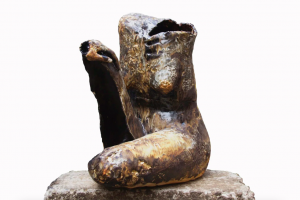
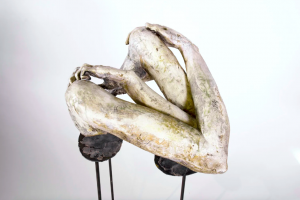
Daniel Clauson is a queer and trans artist whose ceramic forms are deliberately hard to categorise. Resembling torsos or limbs, their architectural shapes resist any fixed reading of the body.
The choice of material is entirely intentional. “It’s a clay body; that’s what you call the kind of clay that you’re working with,” Clauson has explained. “And it is very flesh-like, but it’s boundless. You can create anything within it, and it just made the most sense to create bodies that push the limits of what we understand or normalize, and be able to talk about trans bodies and experiences through that.”
There’s also something about permanence that matters deeply to Clauson’s practice. “As a Queer and Transgender person, conservation and longevity have been displayed to me as unattainable to my identity within this sociopolitical climate,” they explain. “Through ceramics I can prove otherwise, and construct new methods of archiving.”
Jai Sallay-Carrington
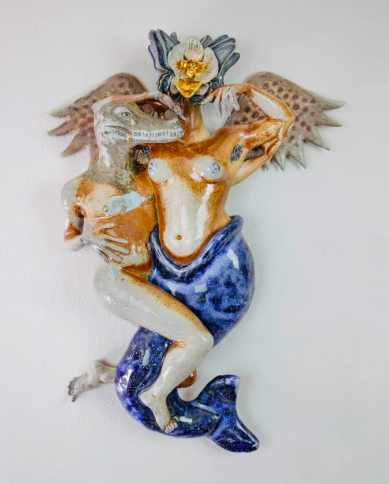
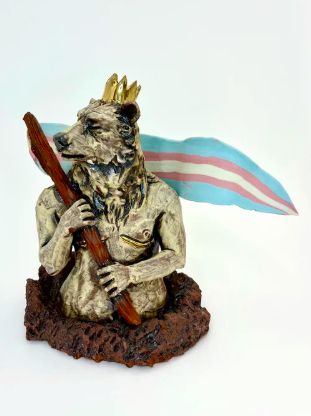
Canadian artist Jai Sallay-Carrington makes figurative sculptures of animal-human hybrids; creatures that carry queer and trans experience in their forms. Their ongoing Trans Passions series goes further still: each sculpture is based on an interview with a transgender person, paired with an audio recording of them speaking about their passions and their life. The sculptures represent their passions, interests and inner lives. “The intention is to showcase trans joy, as often trans bodies are only represented within the discourse of only being trans,” Sallay-Carrington explains. “While transitioning is an important aspect of being trans, the goal of this project is to show the passions and lives that trans people hold as being as unique and diverse as each person is.” So far Jai has interviewed and created sculptures of 20 trans people for the series.
Community is another important strand in their work. The Trans Passions project also includes handmade ceramic pins made by the community, which are available at the opening exhibitions in exchange for a donation to a local organisation which benefits 2SLGBTQIA people.
Storytelling through ceramics
Ceramics is among the oldest surviving records of human culture, and it has never been a neutral record. The stories and legends depicted on ceramic vessels have always reflected the priorities of the societies that produced them. The dominant ceramic traditions passed down through Western art history are no exception: they encode particular bodies, particular relationships, and particular ideas about who deserves to be represented in this permanent form.
The artists featured here are responding to that tradition. Their practice sits within a long tradition of using ceramics as a vehicle for social and political meaning, from the narrative amphorae of ancient Greece to the propagandist porcelain of revolutionary China. They are expanding the historical record for communities whose material culture has been systematically excluded or destroyed. In this context, the act of making work that will outlast its maker is deeply political.
Feeling inspired? At Corrie Bain International Ceramics School, we run weekly evening classes in wheel throwing and hand building in Barcelona. Whether you’re just starting out or returning to the wheel, there’s a place for you in our studio.